
Photos
-
 Crédit : Photo : Mario Lamarre
-
 Crédit : Photo : Mario Lamarre
-
 Crédit : Photo : Mario Lamarre
Artisan·e · Bois et ébénisterie
Lamario
Site web (s’ouvre dans un nouvel onglet)Facebook (s’ouvre dans un nouvel onglet)
Autres textes
Site, vu le 21 oct.
Voici en bref quelques innovations que le Luthier Canadien Mario Lamarre conçoit à son Atelier Montréalais au Québec pour et/ou à la demande des musiciens(nes) professionnels(les).
Monsieur Lamarre fabrique principalement les instruments qui composent le quatuor à cordes ainsi que la contrebasse.
Il a étudié de 1977 à 1980 avec le maître Luthier Italien Sylvio de Lellis qui s'était alors installé au Québec pour fonder un premier Atelier-École Canadien.
Depuis plus de trente-trois ans qu'il explore le merveilleux monde de la lutherie Monsieur Lamarre a développé un style très personnel tel qu'un concept de voûtes à facettes, bien que cela ne l'empêche cependant pas de fabriquer des instruments de type plus conventionnel.
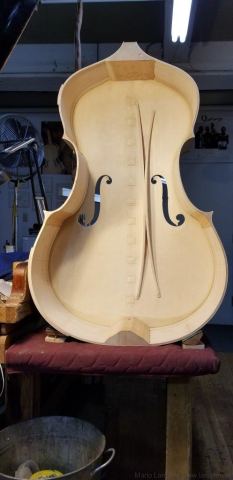
Les voûtes à facettes (8 par table, 4 en bas et 4 en haut) sont l'aboutissement d'une réflexion sur la solidité des tables ainsi que d'une recherche esthétique contemporaine.
Ces facettes sont sculptées à l'image des nervures d'une feuille d'érable, le sommet des plans permet rigidité et souplesse à la voûte.
Le positionnement des facettes s'inscrit dans une recherche des caractéristiques vibratoires des voûtes.
Les deux lignes de force longitudinales sont orientées selon le mode vibratoire du mode 2 (Chaldni Pattern développé par l'acousticienne et luthier Mme Carleen Hutchins et ses équipiers http://www.phys.unsw.edu.au/jw/chladni.html).
La mise d'épaisseur est approximativement la même qu'une voûte classique.
Le premier instrument à facettes daté de 1984 que monsieur Lamarre a réalisé est un violon, et il a su adapté sa théorie concernant les facettes aussi bien aux autres instruments du quatuor à cordes qu'à la contrebasse.
Que serait un instrument de musique sans un musicien pour le faire chanter? L'excellent violoniste professionnel et connaisseur dans le domaine de la Lutherie, monsieur Lajos Molnar, l'encourage dès le tout début.
Il a cru au potentiel de ces instruments et après en avoir joué durant plus de 30 ans, il en est toujours pleinement satisfait.
La sonorité ainsi obtenue confère à l'instrument les mêmes caractéristiques de timbre et de volume qu'une voûte classique traditionnelle.
Une autre de ses innovations concerne la contrebasse.
La contrebasse est un immense instrument qui mesure plus 1 mètre 90, aux proportions plus que généreuses, difficilement transportable et coûtant aux musiciens classiques, de jazz, et populaires appelés à se donner en concert à l'étranger un important supplément dans les avions, ainsi qu'un danger accru de bris.
C'est pourquoi monsieur Mario Lamarre, dans un souci constant de satisfaire sa clientèle fabrique depuis 1995 une contrebasse semi acoustique au manche démontable "Lamario” dont la taille réduite facilite le transport.
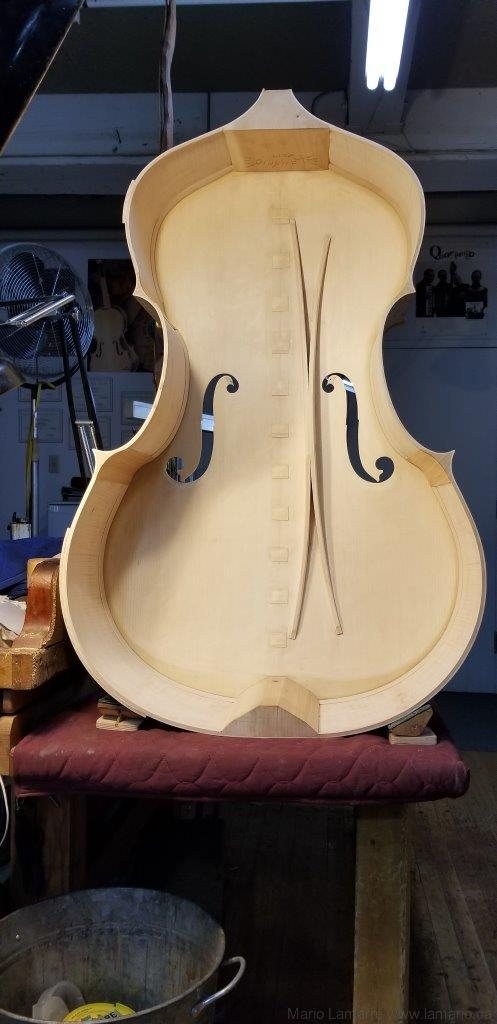
Cette contrebasse a été conçue pour être amplifiée, servir à la pratique acoustique et être transportée de façon compacte.
Le manche est démontable et s'ajuste pour les hauteurs de cordes.
L'épaule en tige d'aluminium est aussi démontable.
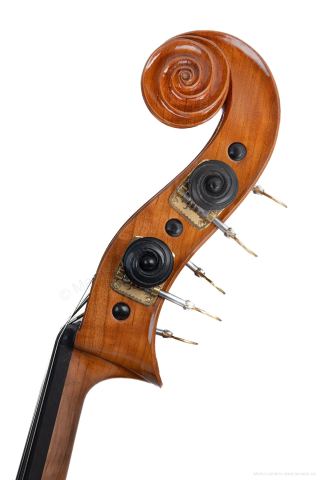
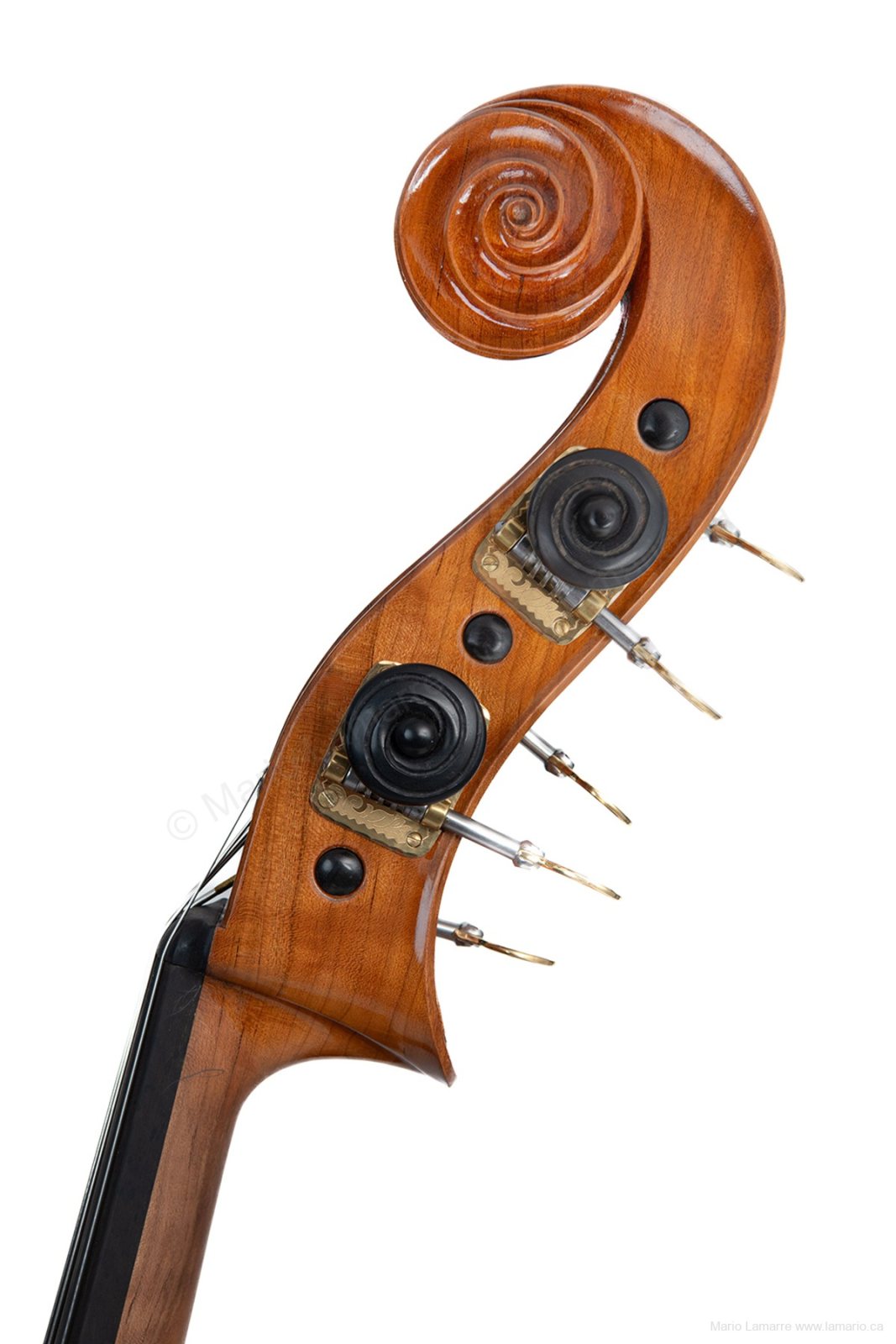
Le cheviller est plus petit et comporte des mécaniques de chevilles légères.
La table est en bois d'épinette, les éclisses en contre-plaqué, plaquées cerisier et le fond est en cerisier massif.
Les foyers harmoniques sont logés dans les éclisses.
La caisse comporte une barre acoustique ainsi qu'une âme.
Le manche est en érable ondé et la touche est en ébène.
Cet instrument sonne, lors de l'amplification en utilisant soit un pick-up sous le pont David Gage, Underwood ou Full Circle, au niveau de son timbre, de sa puissance et de son équilibre comme une contrebasse conventionnelle, elle possède un excellent ‘sustain' et il n'y a aucun problème de ‘feedback'. Cette petite contrebasse peut se transporter dans une housse ou un coffret de 48 pouces de long (voir valises de transport).
Elle se monte et se démonte en 5 minutes et aucun outillage, incluant l'ajustement, n'est requis.
Ce manche démontable peut être adapté à tous types de contrebasses standard1 et la sonorité de l'instrument n'en est nullement affectée.
Un coffre de transport en aluminium fait sur mesure par des professionnels, renforcé et rembourré est présentement disponible pour la contrebasse semi acoustique au manche démontable ainsi que pour une contrebasse au manche démontable.
Voici ce que monsieur Lamarre nous dit à propos de son innovation concernant son manche démontable :
"Avec le temps je me suis rendu compte que le manche démontable ne créait aucun problème d'ajustement, de ‘buzz' et de solidité.
Depuis 1995, j'ai expérimenté ce manche démontable sur une contrebasse de type standard avec l'excellent contrebassiste classique professionnel, monsieur René Gosselin.
À notre grande surprise la sonorité de l'instrument en est devenue plus puissante et plus ouverte.
Depuis, j'en ai réalisé plus d'une cinquantaine, autant pour mes contrebasses que pour des contrebasses anciennes classiques professionnelles, le même phénomène s'est reproduit au niveau du son, alors j'attribue ce gain au fait que le manche peut vibrer légèrement, indépendamment de la caisse.
Ce manche se maintient solidement, uniquement par la tension des cordes.
Les contrebassistes possèdent actuellement de 2 à 3 chevalets ou utilisent des ajusteurs insérés dans les pieds du chevalet à cause des changements climatiques que nous avons en Amérique du Nord.
Ce manche permet l'ajustement en hauteur des cordes ainsi que de trouver le renversement approprié à la basse.
Avec le manche démontable (ajustable), nous pouvons régler la hauteur des cordes au dixième de millimètre près, sans pour autant enlever de la tension sur les cordes.
Il se produit un autre phénomène très intéressant concernant la tension des cordes sur la touche.
Si on utilise un chevalet ajustable lorsqu'on veut remonter les cordes on augmente la tension et son contraire lorsqu'on veut les rapprocher de la touche.
Maintenant avec le manche le phénomène est inversé au niveau des tensions.
Si on veut remonter les cordes de la touche on obtient une diminution de la tension et le son est plus libre et son contraire pour les rapprocher de la touche on augmente la tension ce qui est favorable à l'émission des sons."
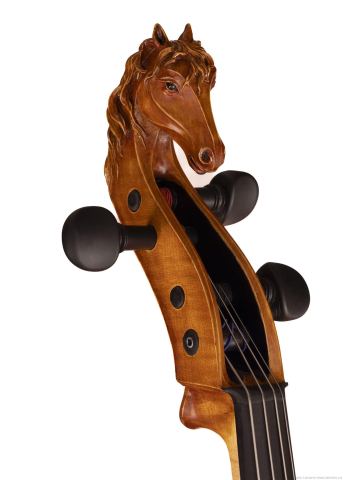
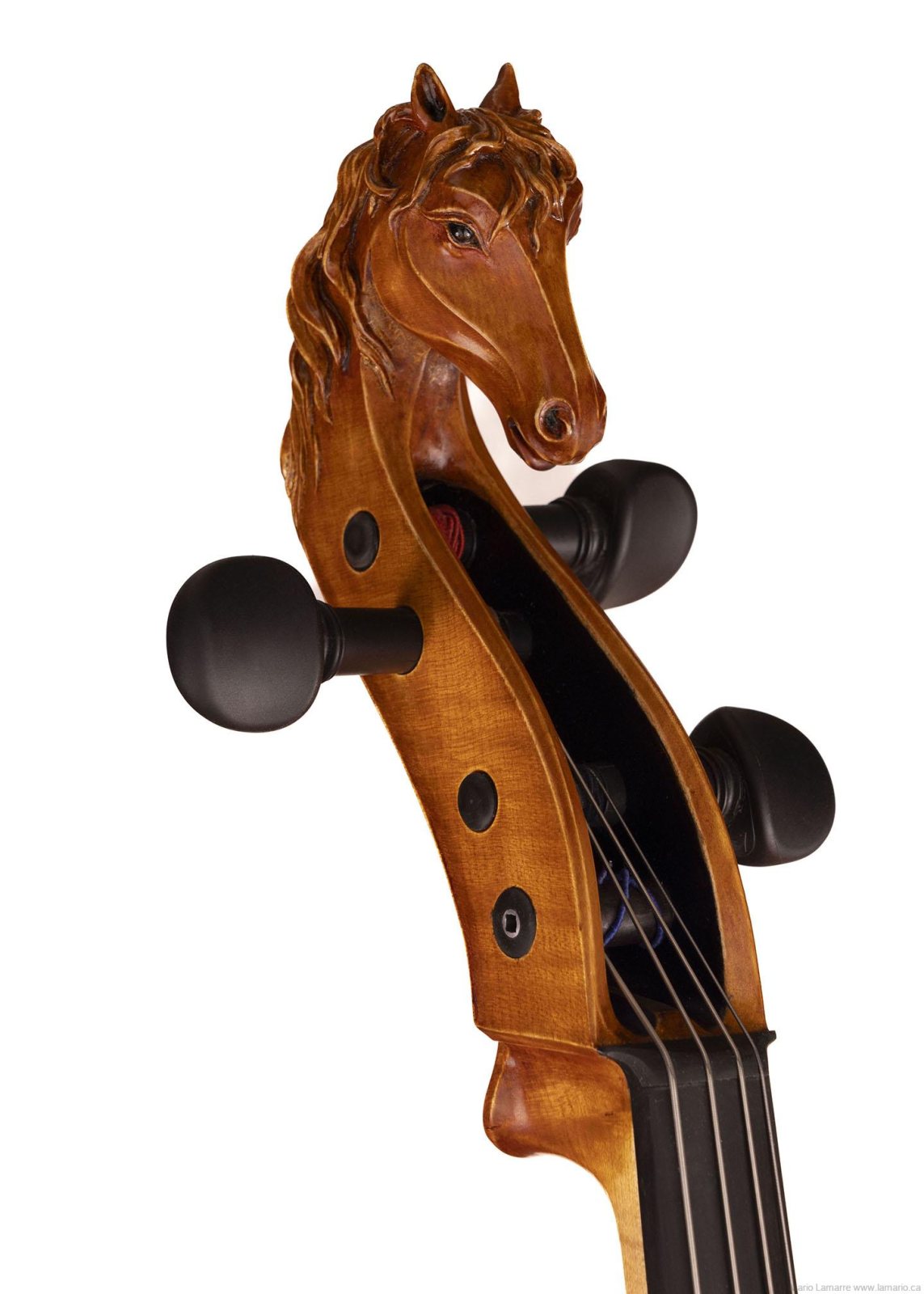
Le besoin d'une extension sur une contrebasse contemporaine l'a amené à développer une extension intégrée avec la tête sculptée (volute traditionnelle et/ou selon le goût du musicien(ne) voir extensions).
L'extension de do permet à une contrebasse 4 cordes d'obtenir le do ou si grave d'une contrebasse 5 cordes.
En ce qui concerne une contrebasse 5 cordes avec extension, une corde en plus de l'aigu, soit un do ou un ré, le musicien a la possibilité de jouer dans le registre du violoncelle.
L'accord s'étend donc du si grave au do ou ré aigu.
N'hésitez surtout pas à nous faire part de vos commentaires, ils seront très appréciés.
1. Un internaute m'a fait connaître un excellent article concernant un manche démontable pour contrebasse fabriqué par Franz Prokop, Bohemian making tradition du début du 19ième siècle, il a été publié par Double Bassist; Issue Number 5, Spring 1998. L'article est disponible sur internet au http://www.contrabass.co.uk/spring98.htm
Site, vu le 21 oct.
Here in short some innovations that Canadian luthier Mario Lamarre has developed at his workshop in Montréal, Québec, for and/or at the request of professional musicians.
Lamarre specializes in making string-quartet instruments as well as double basses (contrabasses).
From 1977 to 1980, he studied with Italian master Sylvio de Lellis, who had come to Quebec to found Canada's first stringed-instrument workshop/school.
Over the more than 33 years that Lamarre has devoted to exploring the fascinating world of stringed-instrument making, he has developed a very unique approach to his craft, including concepts such as the faceted arch, while continuing to make more traditional instruments.
The faceted arch (eight per soundboard, four upper and four lower) is the result of work focusing on the solidity of soundboards and on the quest for a more contemporary design.
These facets are shaped like the veins of a maple leaf, with the top of the planes providing the arch with rigidity and flexibility.
Positioning these facets allows the violin maker to determine the vibratory characteristics of the arches.
The two longitudinal lines of force are oriented according to vibration mode 2 (Chladni pattern developed by acoustician and luthier Carleen Hutchins and her colleagues, http://www.phys.unsw.edu.au/jw/chladni.html).
The thickness distribution is approximately the same as that of a classic arch.
Lamarre made his first faceted instrument, a violin, in 1984, and has since successfully adapted his facet concept for other string-quartet instruments as well as for the double bass.
What would a musical instrument be without a musician to make it sing? Lajos Molnar, an excellent professional musician who is very knowledgeable about the making of stringed instruments, has been a key source of encouragement for Lamarre since the outset. He immediately recognized the potential of Lamarre's innovative instruments, and having played them for over 30 years, remains completely satisfied with their performance.
The sonority created gives the instrument the same tonal and volume characteristics as those produced by a traditional classic arch.
Another of Lamarre's innovations involves the double bass.
A huge, generously proportioned instrument measuring over 1.9 metres, the double bass is difficult to transport, making it very costly for classical, jazz and popular musicians who must pay considerable over-baggage charges to travel by airplane to overseas concerts, as well as increasing the risk of damage.
That's why since 1995 Lamarre, who is constantly looking for new ways to meet his clients' needs, has been making a semi-acoustic "Lamario" bass with a removable neck, a relatively small instrument that is much easier to transport.
This bass is designed to be amplified, to serve as an acoustic practice instrument and to be dismantled for compact transportation.
The neck is detachable and can be adjusted, as can the height of strings in relation to the fingerboard.
The aluminum-rod shoulder is also detachable.
The peg box and the scroll are relatively small and it results a lightweight neck.
The soundboard is spruce, the ribs cherry plywood and the back cherrywood.
The sound holes are located in the ribs.
The body has both a bass bar and a sound post.
The neck is made from flamed maple and the fingerboard from ebony.
When amplified using a David Gage, Underwood or Full Circle under-bridge pickup, this instrument has practically the same tone, power and balance of a conventional double bass, with excellent sustain and no feedback problems.
This small bass can be transported in a cover or case 48 inches long (see cases).
It can be disassembled, reassembled and adjusted in five minutes, without any tools whatsoever.
This detachable neck can be adapted for use with all types of standard double basses1, without impacting the sonority of the instrument.
Professionally made, custom-fit, reinforced and lined aluminum cases are currently available for the semi-acoustic bass and double bass with removable necks (see cases).
Lamarre told us the following about his innovative removable-neck design: "Over time, I've come to realize that the removable neck creates no adjustment, buzz or solidity problems.
Since 1995, I tested this removable neck on a standard double bass with the excellent professional classical musician René Gosselin.
Much to our surprise, it made the sonority of the instrument more powerful and more open.
Since then I've made more than fifty other removable necks, both for my basses and for older professional classical double basses, and the impact on the sound has been the same, so I attribute this enhancement to fact that the neck can vibrate slightly, independently of the body.
This neck is held firmly in place solely by the tension of the strings.
Double-bass players now use two or three bridges or insert adjusters at the base of the bridge to compensate for North American climate changes.
This neck allows you to adjust the height of the strings and to find the appropriate angle with respect to the bass.
With the removable adjustable neck, you can set the string height to within almost a tenth of a millimetre, without reducing the string tension.
Another very interesting thing happens to the tension of the strings on the fingerboard.
If you use an adjustable bridge, the tension increases when you heighten the strings and decreases when you move them closer to the fingerboard.
But with the neck the opposite happens.
When the strings are moved further away from the fingerboard the tension decreases and the sound becomes more open, while bringing them closer to the fingerboard increases the tension, promoting the emission of sound."
To meet the need for an extension on a contemporary double bass, Lamarre has developed an extension that is integrated into the sculpted head (traditional scroll and/or one custom-designed for the musician, see photo).
This C extension allows a four-string bass to produce the low C or B of a five-string bass.
As for a five-string bass with extension, an additional high string, either a C or D, allows the musician to play in the range of the violoncello.
It can then be tuned from low B to high D.
Please do not hesitate to send us your comments.
They will be very much appreciated.
1. An Internet user directed me to an excellent article about a detachable bass neck made by Franz Prokop at the beginning of the 19th century. Entitled "Bohemian Rhapsody," this article was originally published in Double Bassist, Issue Number 5, Spring 1998 and is available on line at http://www.double bass.co.uk/spring98.htm
À venir
Aucune date à venir dans l’agenda.
Sources
Où l’on a trouvé ce que dit cette fiche.
- Site lamario.ca/bio (s’ouvre dans un nouvel onglet) · vu le 22 oct.
- Site lamario.ca/bio (s’ouvre dans un nouvel onglet) · vu le 22 oct.
